
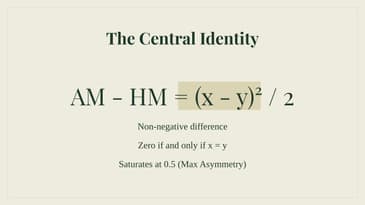
In this lesson, we explore the Pythagorean Mean Differential, a simple and bounded framework for measuring balance in conserved binary partitions where x + y = 1. We’ll derive the three classical mean differentials, examine their mathematical properties, and see why the identity
AM − HM = (x − y)² / 2
provides an intuitive measure of asymmetry that remains bounded even when traditional ratios become unbounded.
Topics covered include:
• The arithmetic, geometric, and harmonic means on conserved partitions
• The three mean differentials
• A bounded alternative to the ratio x/y for measuring asymmetry
• The unique mean-independent point at perfect equipartition
• Applications to Dirac spinors, electromagnetic energy, and binary black hole energy partitions
• Why these identities are exact algebraic consequences of the classical means and the conservation law x + y = 1
This lesson is intended for students, educators, and anyone interested in the beauty of classical mathematics and its applications to modern scientific problems.
⸻
📄 Research Paper
The complete paper, including detailed proofs, derivations, numerical verification, and additional applications, is available on Zenodo:
Mean Differential Diagnostics for Conserved Binary Partitions: A Bounded Asymmetry Measure from the Classical Means
https://doi.org/10.5281/zenodo.18827705
AI Disclaimer: This video features an AI-generated avatar based on my likeness, and the narration uses an AI-generated voice. The educational content and overall message were designed and approved by me.
#Mathematics #PythagoreanMeans #ArithmeticMean #GeometricMean #HarmonicMean #MeanInequality #MathematicalBalance #Asymmetry #BinaryPartition #MathEducation #AppliedMathematics #IndependentResearch #ScienceEducation #STEM #Zenodo